In the Far West of China lies a land that serves as the crossroad between Central Asia and China.
My journey began in Macau where I had a flight to Shanghai and then connected to Kashgar after an overnight at the airport hotel. This route is what I believe to be China’s longest domestic flight taking about 6 and a half hours.
On arrival I headed to the Hyatt UrCove. There are 2 Hyatt UrCove’s in the one complex, so originally I had gone to the incorrect lobby. The room was modern and comfortable. However, the best part of its location just across from the Ancient City of Kashgar. It was very nice to sit and look out of the room window looking at the city’s walls.


I soon headed into the ancient city. The main roads offered many street food options, souvenirs, and also shops where one can rent traditional clothing from the region. However, in my eyes; the real magic lied in strolling through the many side streets. Here there was hardly a visitor and the traditional charm could be felt.


Across the street is another part of the old town called Gaotai Ancient Homes. This area had a similar traditional feeling to the side streets of the Ancient City of Kashgar and also has some workshops where one can see pottery and craftsman doing their work. There is also a viewing platform where one can contrast the old and modern city as well as an archaeological site where one can see what the buildings looked like before their restoration and pottery still partially buried.


I headed to the hotel to meet my friend Scott who was arriving on a flight from Khujand, Tajikistan. We enjoyed a dinner of meat skewers and plov (a Central Asian and Middle Eastern dish of carrots, raisins, and meat).
Day 2:
In the morning it was time to explore more of Kashgar. We began at the Afaq Khoja Mausoleum. It was built by Uyghur religious and political leader Afaq Khoja in honor of his father Muhammad Yusuf Khoja. Overtime it became an impressive complex with multiple mosques, an Islamic religious school (madrasa), and prayer hall. The mausoleum also is also the burial site of over 70 of the Khoja’s family members. This site is built in a very traditional Islamic Central Asian style with Uyghur influences and the tile work reminded me a great deal of the buildings I encountered in Uzbekistan.


We then headed to the top of the Kunlun Tower. Going up there gave an excellent overview of the layout of the city. Honestly, we couldn’t sense just how expansive the ancient city is until we went up the Kunlun Tower.
It also gives an overview of how Kashgar is situated essentially surrounded by mountains at the very western edge of China. It is also a rapidly expanding city with tall buildings going up all around.
We then walked around part of the ancient city to make it to the Id Kah Mosque. The mosque was closed midday until 4pm, so check the opening hours before going. It is an active mosque so only certain parts are open to visitors. However, the architecture is quite nice and the grounds inside expansive with many trees.


Back at the hotel we relaxed a bit and then had some noodles before going to the train station. Our train would take us about 12 hours from Kashgar to Urumqi, the largest city in Xinjiang Region.
Scott and I had booked the deluxe soft sleeper which meant that the two of us had a small cabin to ourselves with a private bathroom. No food served onboard. This was my first time on an overnight train. I spent a lot of the ride coordinating some work. Honestly it’s amazing how much cell service I had. I got a bit of sleep, but it was difficult due to the warm temperature.
Day 3:
Soon enough, it was morning and we were arriving in Urumqi. It was too early to check in to the hotel, but they were very generous and invited us to have breakfast while the rooms were being prepared. I highly recommend the Hilton Urumqi for the excellent facilities, friendly staff, and comfortable rooms.
Honestly, we needed a bit of recovery after the train, so we rested for a few hours before visiting the Hongguangshan Giant Buddha and attached temple. This temple has only been constructed in the past couple decades, but it is a famous site to visit in Urumqi city due to the 40.8 meter tall gilded standing Buddha.
The temple and park surrounding it is a nice place to go walking in the evening as many families are also there.
For dinner we visited a very lively restaurant called Loulan barbecue. I thoroughly enjoyed the lamb heart, liver, and meat skewers as well as tea, bread, and bursak (meat cooked inside a light pastry).
As Scott is in the whisky industry we also visited a whisky bar in the same complex. It wasn’t very busy when we visited (around 10:30pm), but the two bartenders were very friendly and excited to have foreign visitors in their bar.


Day 4:
We had an 8am departure planned for a full day tour to Turpan, a city about 2 hours drive south of Urumqi. What makes Turpan so interesting is just how much drier it is versus Urumqi. It is the lowest point in China and receives only about 2cm of rainfall annually.
Through the hotel we arranged a driver to take us to Turpan round trip and bring us to various sites.
The ride was comfortable, and we primarily took one modern highway all the way there. There was one internal migration checkpoint where our passports were registered, but this took just a couple minutes. Soon enough we arrived at our first stop: the Karez Wells. These underground channel systems allow the region’s residents to have a steady source of drinking water and to grow crops such as grapes. Here in the area there are also many houses where grapes are dried.


We then visited the UNESCO site of Jiaohe / Yarghul ancient city ruins. Jiaohe is the Chinese name, and Yarghul the Uyghur one.
Before you get to the site there is a small museum that shows the daily life of the ruined city’s inhabitants and some maps to give an overview of just how expansive this site is. There are also some adorable goats we fed for 5 yuan!
There is a small cart that first took us to a site from which we walked up to visit some caves which have buddhas painted all over the ceilings and walls. Unbelievably impressive site. Unfortunately, it is not permitted to take photos in any of the Buddha caves (here nor in the 100 Buddha Caves site we visited later in the day).
Then, we took another small cart to the site of Yarghul city. Here we had the freedom to roam around the paths to the residential and religious areas. Due to the limited wood, hot temperatures, and defense benefits much of the city and its buildings were carved into the ground. It was a special feeling to be truly immersed in the walls and alleys of the city.
Before getting the cart back to the car we stopped for a nice watermelon juice squeezed right in front of us!


Then we headed to a scenic zone where grapes are cultivated. This is a sort of leisure park where there are some homes made in the traditional style, animals, and vendors. Honestly, if you are limited on time, it can be skipped. But there was a nice observation tower we went up.


Turpan was a significant city on the Silk Road, and this is apparent in some of the city’s landmark buildings. The most famous perhaps is the Emin Minaret. This brick minaret and mosque was built in honor of Emin Khoja, the Uyghur leader who aligned with the Qing Dynasty, by his son Suleiman.


We stopped briefly at the Flaming Mountain, which gets its name from having a deep red colour and wave live erosion that looks like fire.
Then, we headed to the Bezeklik 1000 Buddha Caves complex, which traces its earliest roots to the 5th century. This is an impressive site with 77 caves that are painted with Buddhist scenes all around. Unfortunately, many of the caves have been destroyed over the centuries, and it is not permitted to take photos inside in order to protect the sensitive colours.
For our final stop of the day we headed to Tuyuk village. This is an ancient oasis of the Taklamakan Desert that is quite picturesque. It is famous also for its mosque which features colourful minarets.


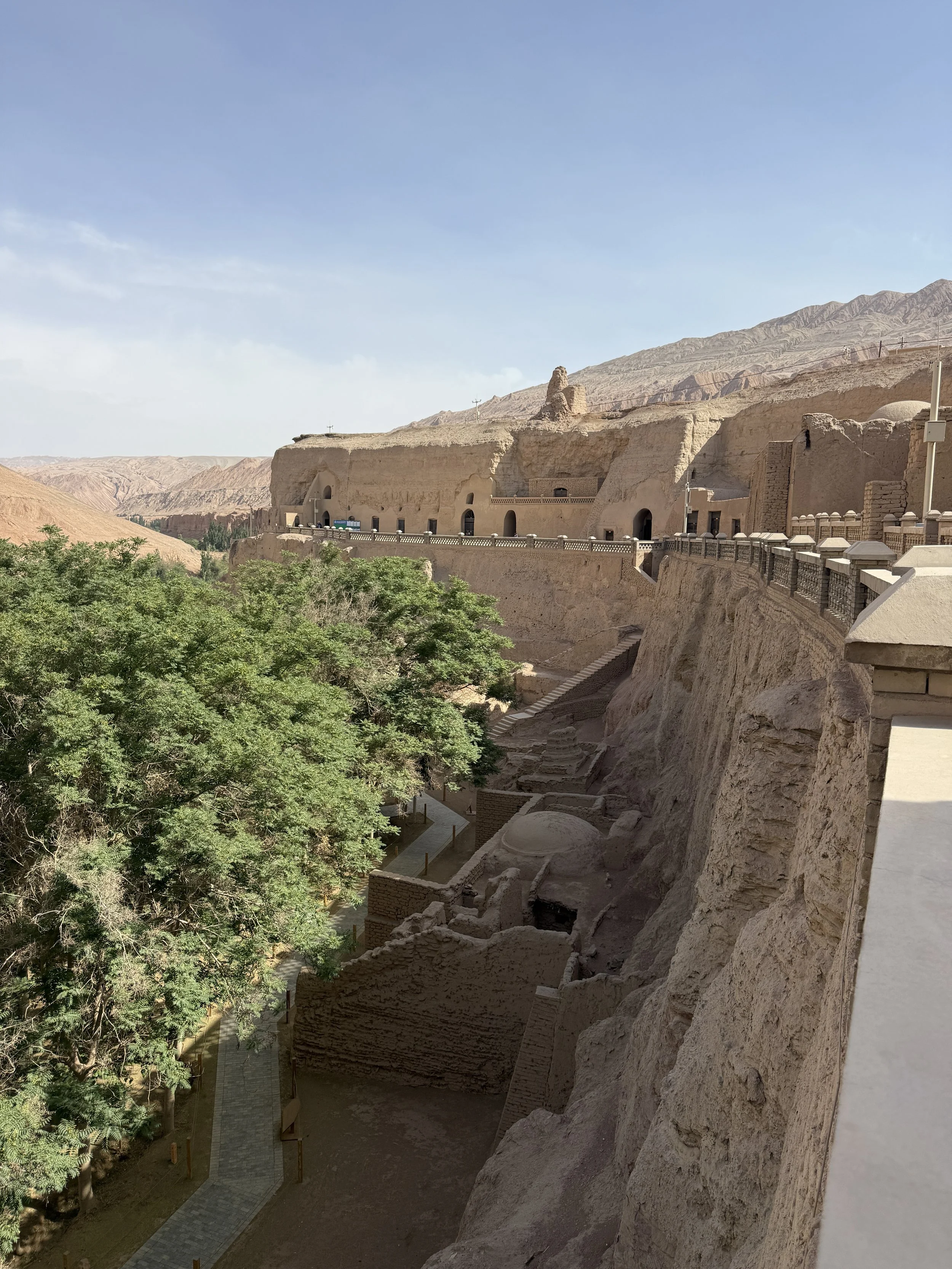
It was an exciting, jam-packed day that left us quite tired, so we were happy to head in the car back to Urumqi.
Day 5:
We had a late afternoon flight from Urumqi to Istanbul, so we stayed in the city today. Our main stop was to the Xinjiang Museum. It is recommended to register for this museum in advance (likely via WeChat), but since we did not have a local phone number this was not possible. However, at the window outside a friendly museum official helped register us without any problems. The museum is free to visit.
Inside, we got to learn a great deal about the history of Xinjiang Region. There is also a model of one of the buddha caves we saw yesterday as well as artefacts such as statues that are from the sites we had visited the previous day. The highlight of this museum is the collection of mummies from the Taklamakan Desert which are almost 4000 years old. Unfortunately, it is not permitted to take photos of the mummies.
Before heading back to the hotel we stopped at a nearby coffee shop. The airport is not far from the city, and we checked in for the comfortable 6 hour flight to Istanbul.


Summary:
This was definitely just a short introduction to Xinjiang Region. I would like to do a much more extensive trip into the countryside here, as the landscapes are supposed to be very unique and impressive. However, I am grateful for the opportunity to have visited, and I so enjoyed my time.